Kisspeptin-10: Structure and Mechanism
What kisspeptin-10 is: its sequence, formula, KISS1R receptor mechanism and what a certificate of analysis should show for lab material.
Written by the Peptide Labs Research Team
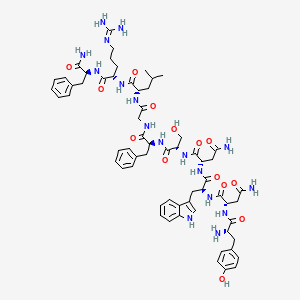
Kisspeptin-10 is a decapeptide amide, the C-terminal fragment of the kisspeptins encoded by the KISS1 gene. PubChem lists it as C63H83N17O14, molecular weight 1302.4 g/mol. In the laboratory it serves as a defined ligand for KISS1R, a G protein-coupled receptor, in cell-based work.
What does kisspeptin-10 bind to?
It binds KISS1R, also called GPR54, a G protein-coupled receptor. A cell-culture study in bovine granulosa cells examined microRNA-1246 as an intermediate in the signalling downstream of the peptide. It is cell-culture mechanism work only.
What are its specifications?
| Property | Value |
|---|---|
| Sequence (human) | Tyr-Asn-Trp-Asn-Ser-Phe-Gly-Leu-Arg-Phe-NH2 |
| Formula (PubChem) | C63H83N17O14 |
| Molecular weight (PubChem) | 1302.4 g/mol |
| Receptor | KISS1R (GPR54) |
How is kisspeptin-10 material tested?
Identity and purity are checked separately. Mass spectrometry confirms the molecular identity, and HPLC reports purity as the main peak's share of total peak area. Read each certificate against both, using the guide to how to read a peptide COA and the explainer on HPLC purity. Certificates are listed on the COA page.
Material sold as kisspeptin-10 for research should match the amidated structure above, because the free-acid form is a different molecule with a different mass.
Research use only
Sold strictly for in-vitro laboratory and research use only. Not for human or animal use, and no therapeutic claim is made.
Sources
- •Kisspeptin-10 compound record. PubChem, US National Library of Medicine.
- •Kisspeptin-10 Promotes Progesterone Synthesis in Bovine Ovarian Granulosa Cells via Downregulation of microRNA-1246. Genes, 2022.
Related Articles
SLU-PP-332: What Is It? Mechanism Explained
SLU-PP-332 is a small molecule ERR agonist sold for in-vitro research in Australia. Read about its mechanism, identity and what a COA should show.
Legal & ComplianceFDA Warning Letters to Research Peptide Sellers
The FDA sent five warning letters to online peptide sellers on 24 August 2026. Why research use labels failed and what it said about BAC water.
Shop Research-Grade Peptides
99%+ HPLC purity · COA verified every batch · Next-day dispatch to Melbourne
Shop All Peptides